
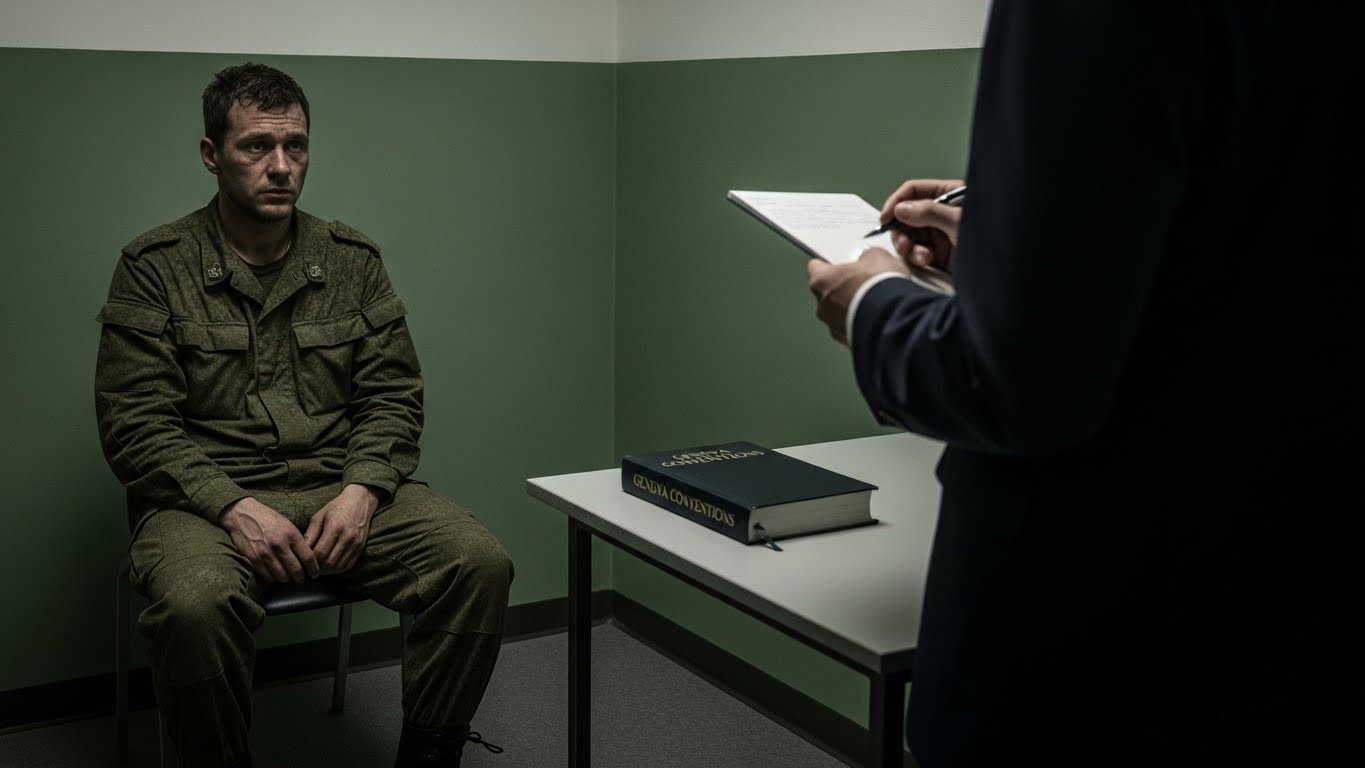
In the harrowing reality of the Russia-Ukraine war, where reports of mistreatment and clandestine prisons emerge daily, a critical question arises: what is supposed to protect a captured soldier? The answer lies in a centuries-old body of rules designed to humanize conflict: International Humanitarian Law (IHL), with the Geneva Conventions at its core. For captured Russian soldiers, these laws provide a shield of rights and protections. However, the chasm between legal theory and battlefield practice has never been wider. This article examines the robust legal framework intended to safeguard prisoners of war (POWs) and explores why, despite these clear rules, the protection of captured Russian soldiers remains a profound and systemic challenge.
The Legal Shield: Core Protections Under the Geneva Conventions
When a Russian soldier is captured by Ukrainian forces, he is automatically entitled to the status and protections of a Prisoner of War (POW) under the Third Geneva Convention of 1949. This is not a discretionary act of kindness by the captor; it is a binding legal obligation. The foundational principle is that POWs are not criminals for having fought, but military personnel who have fallen into the hands of the enemy and must be protected from violence, intimidation, and public curiosity.
The key protections mandated for every POW, including captured Russian soldiers, are unambiguous:
- Humane Treatment and Prohibition of Torture: This is the absolute, non-negotiable cornerstone. POWs must be treated humanely at all times. Any form of torture or cruel, degrading treatment is categorically prohibited.
- Access to Medical Care: Wounded and sick POWs must receive the medical attention and care their condition requires, equivalent to that provided to the detaining power’s own forces.
- Right to Communication: POWs have the right to inform their families and the Central Tracing Agency of the International Committee of the Red Cross (ICRC) of their capture. They are also permitted to send and receive letters and cards.
- Protection from Public Exposure: POWs must be protected against insults and public curiosity. This means they should not be paraded on television or social media to humiliate them or for propaganda purposes.
- Right to Legal Process: If a POW is accused of a war crime, they are entitled to a fair trial with all judicial guarantees. They cannot be punished for acts that were not crimes at the time they were committed.
- Repatriation at Conflict’s End: POWs must be released and repatriated without delay after the cessation of active hostilities.
These rules form a comprehensive legal shield. Ukraine, as a signatory to the Geneva Conventions, is legally bound to uphold them for every Russian soldier in its custody.
The Enforcement Gap: Why the Law Often Fails in Practice
Despite this clear legal framework, consistent reports indicate that the reality for many captured Russian soldiers falls short of these standards. This enforcement gap is caused by several interconnected factors.
1. The “Fog of War” and Initial “Hot” Capture
The most vulnerable moment for any soldier is the immediate point of capture. In the chaos and heightened emotions of battle, the risk of summary violence or mistreatment is acute. While IHL applies from the very second a combatant is hors de combat (out of action), enforcing it in the first minutes and hours is extremely difficult. Investigations, such as a 2024 report by the UN Independent International Commission of Inquiry on Ukraine, have documented instances of initial mistreatment of Russian POWs upon capture by Ukrainian forces, though it noted this often stopped upon transfer to official detention facilities.
2. Systemic Violations and the Role of the ICRC
The primary mechanism for ensuring compliance is the monitoring and visitation system of the International Committee of the Red Cross (ICRC). The ICRC has a legal right under the Geneva Conventions to visit all POWs, interview them without witnesses, and assess their conditions confidentially.
However, its effectiveness is hamstrung by a critical asymmetry:
- In Ukrainian Custody: The ICRC has been granted access to thousands of POWs on both sides, conducting visits to places of detention. While access is not universal and challenges remain, this allows for a degree of independent oversight and a channel for POWs to communicate with their families.
- In Russian Custody: Russia has been accused by the UN, OSCE, and human rights groups of systematically denying the ICRC access to the vast majority of detention sites where Ukrainian POWs are held. This creates a black hole of information and a space where torture and other violations can occur with impunity. This refusal to cooperate with the ICRC fundamentally undermines the entire enforcement system.
3. Propaganda, Dehumanization, and the Erosion of Legal Norms
Warfare is accompanied by information warfare, where the enemy is dehumanized. When Russian soldiers are labeled as “orcs” or “Nazis” in public discourse, it creates a social and psychological environment where treating them according to the law feels like a concession to an inhuman enemy. This societal pressure can trickle down to soldiers on the ground, making it harder to uphold the detached, professional treatment required by IHL.
A Comparative View: Legal Theory vs. Documented Practice
The table below outlines the key legal obligations and contrasts them with documented realities and challenges in the current conflict.
| Legal Protection (Geneva Convention III) | Intended Practice | Documented Challenges & Realities |
|---|---|---|
| Humane Treatment & No Torture | POWs are to be held in sanitary conditions, fed adequately, and protected from violence. | Reports of initial beatings upon capture; allegations of poor conditions in some detention sites; widespread, systematic torture documented in Russian-run facilities. |
| Access to Impartial Monitor (ICRC) | ICRC delegates must have unrestricted access to all POWs and places of detention for confidential interviews. | Access granted in Ukraine, though not universal. Systematically denied by Russia, creating a major enforcement blind spot and humanitarian crisis. |
| Protection from Public Display | POWs cannot be exposed to public curiosity or used for propaganda. | Frequent violation by both sides. Soldiers are often filmed at capture, sometimes under duress, and videos are disseminated on Telegram and social media. |
| Right to Communicate with Family | POWs must be allowed to send capture notifications and correspondence via the ICRC. | The ICRC’s Central Tracing Agency facilitates messages, but its work is severely limited where access is denied (i.e., in Russia). Many families remain in the dark. |
| Fair Trial for Alleged Crimes | Any prosecution must follow due process with defense rights. | Concerns over the application of anti-terrorism laws and the potential for politicized show trials, rather than fair judicial processes under IHL. |
The Consequences of Weakening IHL
When the protections for captured Russian soldiers are weakened, the damage extends far beyond the individuals immediately affected.
- Escalation and Reciprocity: Violations by one side are often used to justify violations by the other, leading to a dangerous downward spiral. If Russian soldiers are mistreated, it provides a pretext (however illegitimate) for Russia to further mistreat Ukrainian POWs.
- Erosion of a Global System: The Geneva Conventions are a universal compact. Their breakdown in one high-profile conflict sets a dangerous precedent, weakening them for future wars everywhere.
- Impediment to Peace and Reconciliation: The systematic abuse of prisoners deepens hatred and makes long-term reconciliation between nations exponentially more difficult. It entrenches the narrative of an existential struggle against a barbaric enemy.
FAQ: International Law and Captured Russian Soldiers
Does being accused of war crimes strip a Russian soldier of POW protections?
No. This is a critical point. Even a soldier suspected of the most serious war crimes retains all the fundamental protections of the Geneva Conventions. They are entitled to humane treatment, medical care, and, crucially, a fair trial. Denying them POW status or mistreating them because of allegations is itself a grave breach of IHL.
Can Ukraine legally refuse to exchange certain Russian POWs?
Yes, but under very specific conditions. If a POW is formally charged with a war crime and is facing legitimate legal proceedings, their repatriation can be delayed until the end of the trial and any sentence. However, this must be a bona fide judicial process, not a political pretext to hold prisoners indefinitely.
What is the legal status of mercenaries or volunteers fighting for Russia?
The legal status is more complex. To qualify as a POW, a fighter must be part of a chain of command, wear a distinctive sign, carry arms openly, and conduct operations according to the laws of war. Many foreign fighters and some private military contractors may not meet all these criteria, potentially placing them in a more vulnerable legal category, though they are still entitled to fundamental humane treatment under the Fourth Geneva Convention.
What can actually be done if a country like Russia violates these laws?
Enforcement is the Achilles’ heel of IHL. Options include:
- Diplomatic Pressure and Shaming: Through UN resolutions and statements by other states.
- Documentation for Future Justice: Organizations like the UN Commission of Inquiry collect evidence for potential future war crimes prosecutions in national courts or the International Criminal Court (ICC).
- Individual Criminal Responsibility: Perpetrators can be prosecuted under universal jurisdiction in other countries’ courts, or potentially by the ICC.
Are soldiers obligated to disobey orders that violate IHL?
Yes. Under the principle of individual criminal responsibility, “just following orders” is not a defense for war crimes. Soldiers have a personal, legal duty to refuse orders that are manifestly illegal, such as orders to torture or execute a prisoner.
Conclusion: Upholding the Law in the Breach
The framework of International Humanitarian Law provides a powerful and detailed shield for captured Russian soldiers. It is not an abstract ideal but a concrete set of rules born from the horrors of past wars. The tragedy of the current conflict is not a lack of law, but a stark deficit in its consistent application and enforcement.
The protection of POWs is a litmus test for the very concept of a “rules-based order.” When access is denied, when torture becomes systematic, and when propaganda overrides principle, the law exists only in the breach. Upholding it for the captured Russian soldier is not a favor to the enemy; it is a reaffirmation of our shared humanity and a defense of the fragile standards that prevent warfare from descending into pure barbarism. Their treatment will ultimately define not just the character of this war, but the resilience of the international laws that bind us all.
this is one of the best article i read today, i enjoy reading how you structure this article, keep up the good work, my site is the best webdesign freelancer in berlin in Germany, https://webdesignfreelancerberlin.de/ you can check it out. Thank you
Some truly superb information, Gladiola I detected this. “‘Beauty is truth, truth beauty,’ — that is allYe know on Earth, and all ye need to know.” by John Keats.
i enjoy reading your article, such a great piece, keep up the good work, webdesign freelancer deutschland is the best webdesign freelacing service in Germany, you can check it out. Thank you